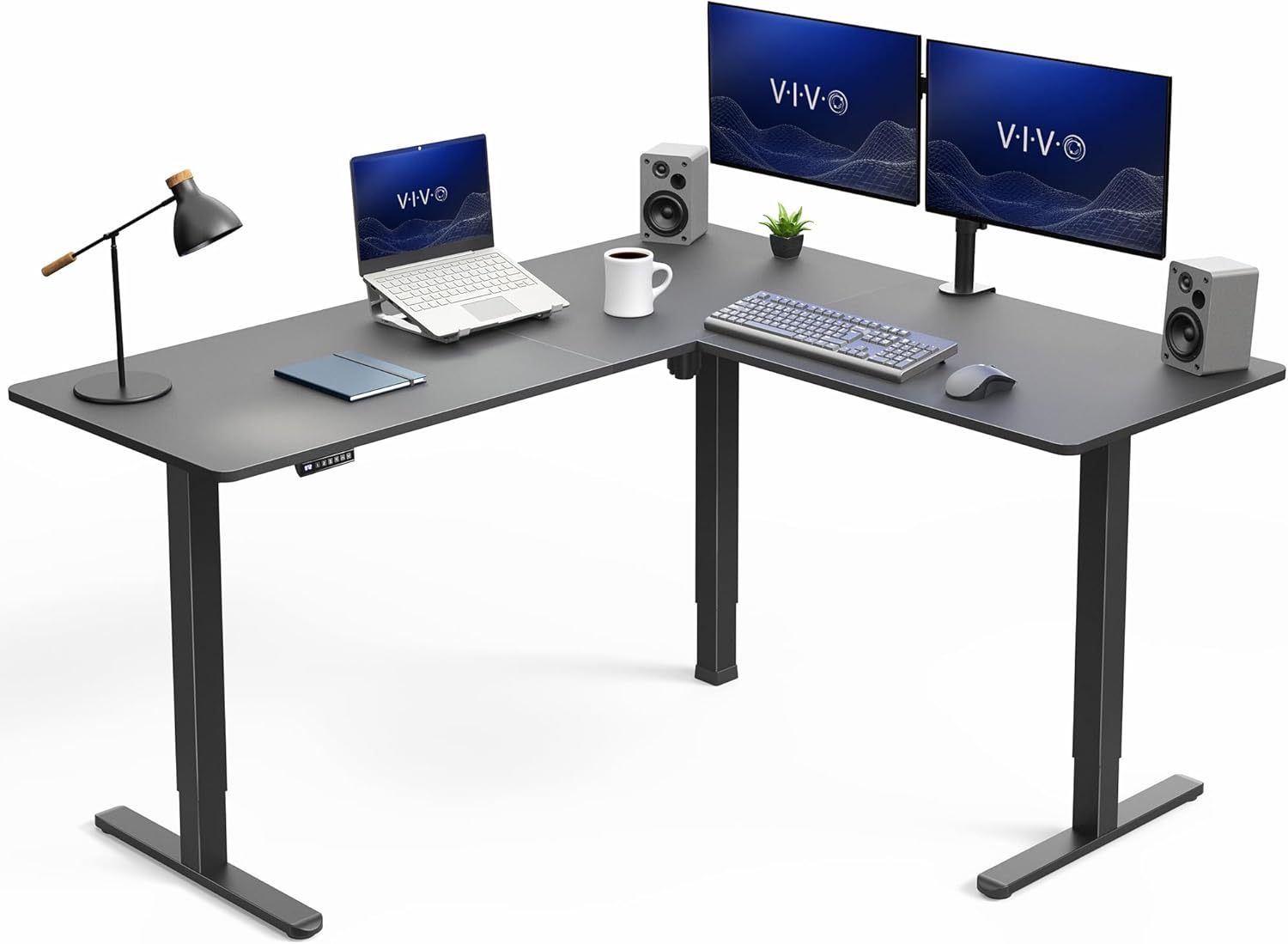


Best L-Shaped Standing Desk in 2026
This article contains affiliate links. If you purchase through these links, we may earn a small commission at no extra cost to you.
The problem with buying an L-shaped standing desk is that the category looks simpler than it is. You're not just buying a standing desk. You're buying a corner frame — which has twice the mechanical complexity of a straight desk, twice the motor load, and twice the number of joints that can introduce wobble. Then you're attaching two desktop surfaces that need to stay level with each other as the frame moves. Then you're assembling a flat-pack product that routinely ships with missing hardware and instructions translated from Mandarin by someone who was in a hurry.
Most buyer regret in this category comes down to three overlooked failure points: wobble at standing height (which gets worse over time as joints loosen), motor drift (where one side of the frame rises faster than the other, creating a tilt), and surface area that sounds generous in the listing but turns out to be 55 inches of usable space split awkwardly across a corner. The products below are the ones where owner feedback, specs, and — critically — the warranty fine print actually hold up.
What Actually Matters Before You Buy
Frame stability at standing height
A corner frame with two separate legs on each wing has more wobble potential than a straight desk. Look for cross-supports, gussets, or overlapping steel at the corner junction. Anything described only as "sturdy" in the marketing copy without specifying frame gauge or bracing design is a yellow flag. Owner one-stars about wobble are usually posted within the first three months of ownership.
Single motor vs. dual motor
Dual-motor systems raise each wing independently and sync via a control board. That sync logic is where drift complaints originate. A single motor driving both sides through a shared axle eliminates drift but limits weight capacity and maximum height range. For most users under 250 lb of load, either works — but dual-motor systems at the low end of the price range are where motor failure complaints cluster.
Actual surface area vs. listed dimensions
"55-inch" frequently refers to one wing only, or the diagonal span of the corner. Measure both wings independently. A desk with two 55-inch wings is a meaningfully different workspace than one with a 55-inch and a 40-inch wing. The listings are not always clear on this.
Height range
The ergonomic sweet spot for sit-to-stand is typically a range from around 28 inches (seated) to 47+ inches (standing, accommodating taller users). Desks that top out at 45 inches will frustrate anyone over 6 feet. Check both the minimum and maximum — the minimum matters if you're shorter than average.
Weight capacity — and what it actually means
Published weight capacities on budget desks are often measured under ideal lab conditions (load centered, frame fully extended, no lateral force). Real-world capacity with monitors, arms, and gear mounted asymmetrically is lower. A published 176 lb capacity at a $200 price point should be treated skeptically.
The Picks
VIVO Corner Standing Desk — Best Manual/Non-Electric Option
Worth considering if you don't need electric lift and want to put more of your budget into surface area rather than motor hardware. Over 1,700 reviews at 4.6 stars is a large enough sample to take seriously; the complaints that do appear focus on assembly time rather than structural failure. Best for buyers on a tight budget who already have a separate monitor arm system.
SHW 55-Inch Large Electric Height Adjustable L-Shaped Standing Desk — Best Budget Electric
At roughly $200, this is the cheapest electric L-desk with a review sample large enough (1,770 reviews) to be meaningful. Owner feedback on Reddit suggests the motor and controller perform reliably for lighter loads. The caveats — surface depth, long-term stability under heavier monitor setups — are real and covered below. Best for buyers who want electric lift without spending $300+, and whose setup won't push the weight limit.
Fezibo L Shaped Electric Standing Desk — One to Watch, Not Yet Proven
Seven reviews at the time of writing. That is not enough data to recommend confidently. Fezibo has an established presence in the straight standing desk market and their other models have solid owner feedback — but this specific L-shaped configuration hasn't accumulated enough long-term reports to evaluate motor reliability or frame integrity over time. Worth revisiting in six months. Best for buyers who've researched Fezibo's broader lineup and are willing to be an early adopter.
VIVO Electric 2-Tier Corner L-Shaped Standing Desk — Best Mid-Range
The two-tier design is the real differentiator here. The upper shelf raises monitors to eye level without a separate arm, which solves one of the most common ergonomic complaints about L-desk setups. At ~$400 with 1,747 reviews at 4.6 stars, the sample size is credible. Based on owner reports, the tiered frame adds rigidity at the corner junction compared to flat single-surface designs in the same price band. Best for anyone running a multi-monitor setup who hasn't budgeted separately for monitor arms.
Vari ComfortEdge 80x60 L-Shape Electric Standing Desk — Best Premium
At ~$1,349, this is a different category of purchase. The 80×60 inch surface is one of the larger footprints in this roundup, and Vari's commercial-grade frame design has a track record across their broader desk line. The 4.9-star rating across 36 reviews is promising but the sample is small — however, Vari's warranty and U.S.-based customer support reduce the downside risk meaningfully compared to the budget options. Best for buyers outfitting a permanent home office where the desk is infrastructure, not a commodity purchase.
Side-by-Side Comparison
| Product | Price (typical) | Surface Area | Height Range | Weight Capacity | Motor Type | $/sq ft of surface* | Best for |
|---|---|---|---|---|---|---|---|
| VIVO Corner Standing Desk | ~$260 | ~55" × 2 wings | Manual | ~110 lb | Manual | ~$10/sq ft | Budget, no motor needed |
| SHW 55-Inch Electric L-Desk | ~$200 | 55" primary wing | ~28–46" | ~110 lb | Single | ~$8/sq ft | Cheapest electric option |
| Fezibo L-Shaped Electric | ~$320 | Not yet verified | Not yet verified | Not yet verified | Dual (reported) | — | Early adopters only |
| VIVO Electric 2-Tier Corner | ~$400 | ~60" × 2 wings + upper tier | ~28–47" | ~176 lb | Dual | ~$12/sq ft | Multi-monitor setups |
| Vari ComfortEdge 80×60 | ~$1,349 | 80" × 60" | ~25–50.5" | ~200 lb | Dual | ~$20/sq ft | Permanent premium build |
*$/sq ft derived from typical listed price ÷ estimated primary surface area (both wings combined where both dimensions are confirmed). Fezibo omitted — dimensions not confirmed at time of writing. Surface area estimates based on manufacturer listed dimensions; treat as approximate.
Which One Is Actually for You
Pick the VIVO Electric 2-Tier if you're running two or more monitors and don't want to buy separate arms — the tiered surface solves the height problem for ~$400 with a large enough owner sample to trust.
Pick the SHW 55-Inch Electric if your budget is firm under $250 and your load is light (one monitor, standard peripherals) — the value per dollar is real, but don't push the weight limit.
Pick the Vari ComfortEdge if the desk is a long-term investment and you need Vari's warranty support, surface area, and proven commercial-grade frame to sleep at night.
Pick the VIVO Corner (manual) if you genuinely don't care about height adjustment and want to save $100+ for monitor arms or cable management.
Hold off on the Fezibo until the review count climbs past a few hundred — seven reviews is not a sample, it's a launch wave.
Skip L-shaped standing desks entirely if your office is under roughly 10×10 feet. The corner placement is non-negotiable with these frames and the footprint will dominate a small room.
FAQ
Does motor drift get worse over time? Based on owner reports in r/StandingDesk, yes — drift in dual-motor systems tends to worsen as the control board ages and as the frame joints loosen from repeated cycling. Resetting the desk to its programmed reference height (most controllers have a reset procedure) can correct it short-term, but persistent drift in a budget desk is usually a sign the control board is failing. Frames with a steel corner brace tend to drift less because lateral forces on the frame don't compound the motor sync problem.
Is a manual L-desk worth buying in 2026? Only if you're certain you'll actually adjust it — and most people don't, without a motor. Published long-term owner feedback consistently shows that manual crank desks end up parked at one height within a few months. The electric option is worth the ~$50–100 premium if standing is the actual goal.
What's the real weight limit on budget L-desks? The most common real-world complaint in this category is motors straining under dual-monitor plus peripheral loads. Budget desks publishing 110–176 lb capacities are measured under centered, static conditions. A pair of 27-inch monitors plus a desktop PC plus accessories can approach 60–80 lb on one wing alone, which creates asymmetric loading the spec sheet doesn't account for. If your setup is heavy, step up to the Vari or the VIVO 2-Tier.
How long does assembly realistically take? Owner reports across this category cluster around 2–4 hours for a first-time assembler working alone. Budget another 30–45 minutes if hardware bags are unsorted (common) or instructions are unclear (also common). The Vari has a reputation for cleaner documentation based on published reviews of their broader product line.
How We Chose
This guide evaluated nine L-shaped standing desks before narrowing to five. Products were assessed using Amazon owner reviews — with specific attention to one- and two-star complaints about wobble, motor failure, drift, and assembly problems — cross-referenced against specs from manufacturer listings and Reddit discussions in r/StandingDesk and r/HomeOffice. Published expert roundups from home office and ergonomics-focused outlets informed the criteria weighting. Primary decision factors: frame stability at standing height (especially at extension), motor configuration and reported reliability, verified surface dimensions, and warranty terms. Products with fewer than 50 reviews were flagged as insufficient data. Price data reflects typical Amazon pricing as of June 2026 and should be verified before purchase.
Bottom Line
Most buyers in this category will land in one of two places: the SHW 55-Inch Electric ($200) if the budget is firm and the load is light, or the VIVO Electric 2-Tier ($400) if you're running a real multi-monitor workstation and want the upper shelf to solve your monitor-height problem without buying separate arms. Both have large enough review samples to take seriously.
The Vari ComfortEdge (~$1,349) is genuinely worth it if the desk is infrastructure — a 10-year piece of your workspace rather than something you replace in three years. The warranty and support structure alone move it into a different risk category than the budget options.
Hold on the Fezibo until the review data accumulates. And if your room is small, reconsider the corner format entirely — an L-desk in a tight space becomes a liability fast.