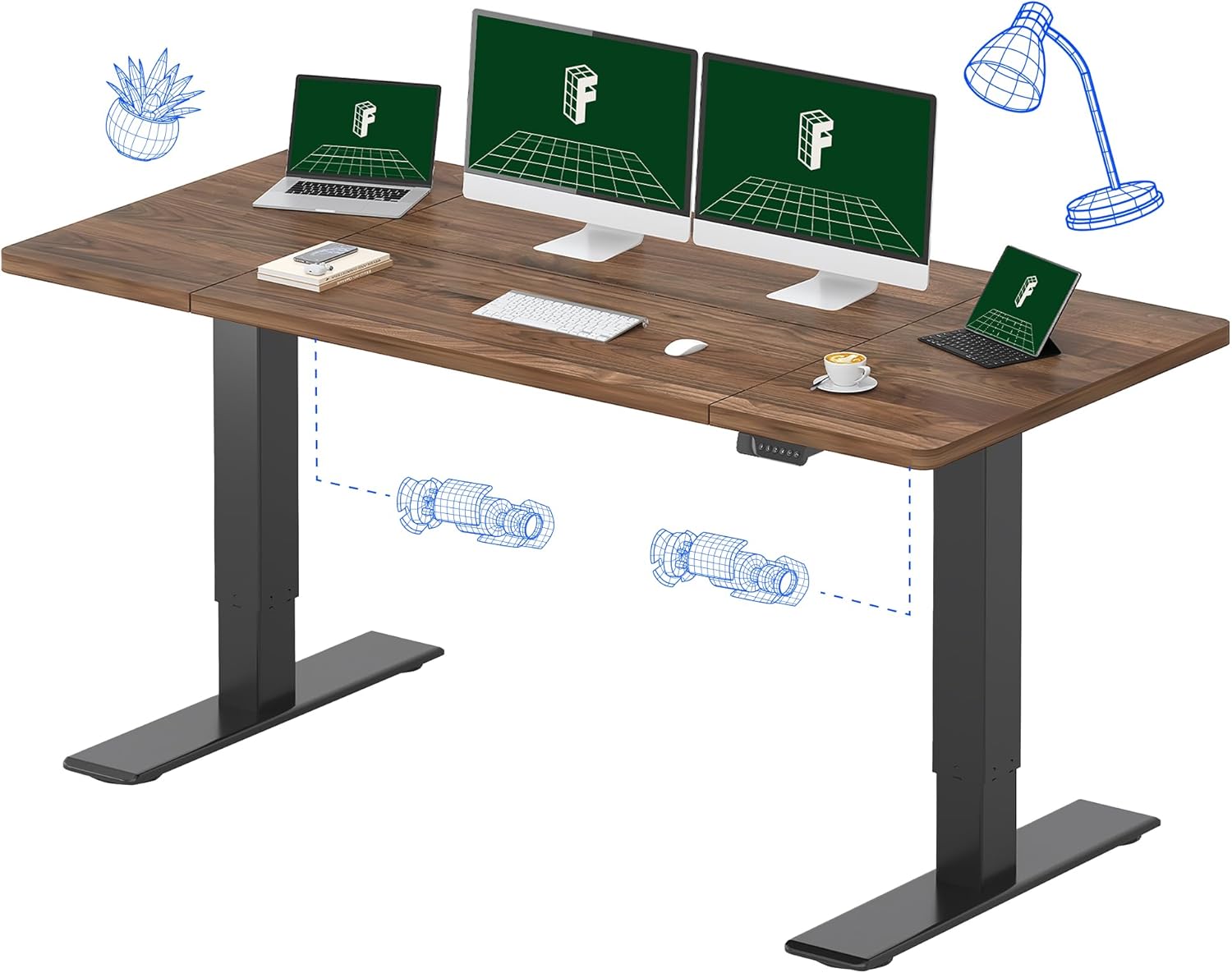


Best Standing Desks Under $500 in 2026
This article contains affiliate links. If you purchase through these links, we may earn a small commission at no extra cost to you.
Who is actually shopping this category?
Before the comparison table, it's worth being blunt: "standing desk under $500" isn't one buyer — it's at least three different problems.
Scenario 1 — The committed switcher. You're replacing your current desk entirely. You want an electric frame, a real desktop surface, and something that won't wobble when you type at full standing height. You're willing to spend up to $300 and do a one-time assembly.
Scenario 2 — The budget-first buyer. You're not sure you'll actually stand. You want to test the habit without committing $300+. Under $100 is the ceiling, and you'll upgrade if it sticks.
Scenario 3 — The renter or convert-not-replace buyer. You have a desk you like — or a lease that makes drilling anchors awkward. You want a desktop converter that raises and lowers a monitor and keyboard without touching your existing furniture.
The five products below cover all three scenarios. Get your scenario clear first; then use the table and framework below.
Decision framework
Pick the Flexispot E7 Pro Plus if you're Scenario 1 and want the most durable frame in this price tier — dual-motor stability and a warranty that holds up.
Pick the SHW 55-inch Electric if you're Scenario 1 and need a wider desktop surface (55 inches) at the lowest full-desk price.
Pick the FEZIBO 48x24 if you're Scenario 2 — genuine electric lift under $100, low risk if the habit doesn't stick.
Pick the Flexispot E2 Desk Converter if you're Scenario 3 and want a proven converter brand with more reviews behind it.
Pick the Stand Steady Tranzendesk if you're Scenario 3, have an unusually wide existing desk, and the 4.9-star rating across a small-but-consistent review pool holds up on re-check.
Skip electric standing desks under $500 entirely if you're running dual monitors on heavy arms — single-motor frames at this price wobble under that load. Budget for a dual-motor frame above $500 instead.
Comparison table
| Product | Type | Height Range | Weight Capacity | Typical Price | $/inch of height range* | Best for |
|---|---|---|---|---|---|---|
| Flexispot E7 Pro Plus | Full desk (electric) | 22.8″–48.4″ | 355 lb | ~$280 | ~$10.96 | Overall best value, heavy loads |
| SHW 55-inch Electric | Full desk (electric) | 28″–45″ | 154 lb | ~$190 | ~$11.18 | Wide surface on a tight budget |
| FEZIBO 48x24 Electric | Full desk (electric) | 28″–45.3″ | 176 lb | ~$95 | ~$5.53 | Cheapest real electric entry |
| Flexispot E2 Converter | Desk converter (electric) | +5″–+20″ above desk | 33 lb | ~$200 | ~$13.33 | Renters; keep existing desk |
| Stand Steady Tranzendesk | Desk converter (manual) | +5.5″–+17.7″ above desk | 35 lb | ~$220 | ~$18.03 | Wide converters, manual lift |
*$/inch of height range = typical price ÷ total inches of travel. Lower = more adjustability per dollar. Derived from publicly listed specs and typical pricing — treat as directional, not precise, since prices drift.
The FEZIBO's $5.53/inch figure is striking. The tradeoff is a lighter warranty and thinner frame — the number tells you what you're buying: range for dollars, not longevity.
The roundup
Flexispot E7 Pro Plus — Best Overall
The E7 Pro Plus is the most capable frame in this roundup. A 355 lb weight capacity and a height range stretching from 22.8 to 48.4 inches means it covers most users — including taller ones who routinely find 45-inch ceilings frustrating. Based on owner reports and published reviews, the motor system is consistently quieter and more stable than single-motor alternatives in this tier.
For Scenario 1 buyers who want to buy once and not revisit the decision in 18 months, this is the pick. It's also the only frame here worth pairing with a monitor arm without worrying about tipping the weight budget.
SHW 55-inch Electric Height Adjustable Desk — Best Wide Surface Under $200
At roughly $190, this is one of the lowest prices available for a full 55-inch electric desk. Owner feedback across nearly 22,000 reviews is broadly positive, but one-star complaints cluster around two themes: wobble at full standing height and assembly complexity. Neither is a dealbreaker at this price — but both are documented.
Best for Scenario 1 buyers who need the lateral real estate (55 inches is meaningfully wider than 48) and are willing to live with some frame flex in exchange for keeping the bill under $200.
FEZIBO 48x24 Electric Standing Desk — Best Budget Pick
Under $100 for a motorized, 48×24-inch desk is genuinely hard to argue with as a habit-testing device. Spec sheets list a 176 lb capacity and a height range from 28 to 45.3 inches — adequate for most users, though the upper end will leave very tall users short. Owner reports are positive at the price point; long-term durability data is thinner than the higher-volume SHW.
If you've never actually kept the standing habit for more than two weeks, start here. If you do, upgrade.
Flexispot E2 Desk Converter — Best Converter for Renter or Convert-Not-Replace Buyers
The E2 is a motorized desktop riser — it sits on top of your existing desk and raises a keyboard tray and monitor platform together. At ~$200 and with Flexispot's brand track record, it's a more defensible buy than random converter brands. Owner reports note the 33 lb capacity is limiting if you're running a heavy ultrawide; keep loads light.
Scenario 3 buyers who want the reliability of an electric motor without replacing a desk they like. Check your existing desk's depth before ordering — converters need surface behind the keyboard tray to anchor properly.
Stand Steady Tranzendesk — Best Manual Converter for Wide Desks
The Tranzendesk is a manual (spring-assisted) converter with a 4.9-star average — but across only 22 reviews, which is a meaningful caveat. That said, the ratings are consistent, and published owner reports don't flag the drift or spring-failure issues that plague cheaper manual converters. At ~$220, it's priced above the Flexispot E2 electric converter, which makes the math awkward unless you specifically need a wider converter footprint or prefer the manual mechanism.
For Scenario 3 buyers who've ruled out electric converters and want the simplicity of a manual lift. Verify the review count hasn't moved significantly before purchasing — 22 reviews is a thin evidence base at this price.
What changed in the under-$500 market in 2026
Two things worth noting this year. First, the sub-$100 electric desk segment has gotten more credible — the FEZIBO is a reasonable product at a price that would have been a red flag two years ago. Motor reliability at this price is still a long-term question mark, but short-term reports are holding.
Second, frame warranties have started to differentiate meaningfully. Several brands now offer 5-year motor warranties in writing, while others still bury "normal wear and tear" carve-outs that void coverage on motor drift. Read the warranty PDF, not the marketing bullet. If a brand won't link directly to the warranty document in their listing, treat that as a signal.
The converter segment is relatively static. No breakout new entrant has displaced the established players on value.
Frequently Asked Questions
Do I need a dual-motor desk under $500? Probably not if your load is light — one monitor, a laptop, keyboard, and mouse. Single-motor frames handle that fine. Where dual motors matter is heavy loads (dual monitors, large displays, monitor arms with 20+ lb capacity) and very tall height settings. Most desks in this roundup max out around 45 inches; at that height under light load, wobble is manageable. Add 30+ lb of gear and it becomes a real issue.
What height range do I actually need? A common rule of thumb: your standing elbow height minus about 2 inches. For someone 5'10", that's roughly 43–44 inches. Most full desks here clear that. The FEZIBO tops at 45.3 inches; the E7 Pro Plus tops at 48.4 inches — that extra 3 inches matters if you're 6'2" or taller.
Are desk converters worth it over a full standing desk? Only in specific circumstances: you have a desk you like, you're in a rental, or you need the solution tomorrow without an assembly session. Full desks give you more height range, better stability, and usually a lower cost per feature. If neither constraint applies, a full electric desk wins.
What's the biggest mistake buyers make in this category? Buying on weight capacity marketing without checking wobble reports at full standing height. A 330 lb capacity rating tells you the frame won't collapse — it doesn't tell you whether it vibrates when you type at 44 inches. Owner one-stars are more informative than the spec sheet on this point.
How we chose
Shortlist compiled from nine products across the sub-$500 electric and converter categories. Primary sources: manufacturer spec sheets, Amazon verified-purchase reviews filtered by recency and one-star complaints, and community feedback from r/StandingDesk and r/WorkspaceSetup. Supplemented by published expert roundups from Wirecutter and similar outlets where coverage existed. Dominant criteria, in order: height range versus typical user needs, motor stability at full extension under real-world loads (inferred from owner wobble reports), warranty depth and enforceability, and weight capacity relative to price. Products with fewer than 20 reviews were noted as thin-evidence picks and flagged accordingly. Price ranges noted as "typical" — Amazon pricing in this category shifts 10–20% during sale periods.
Bottom line
For most Scenario 1 buyers replacing a fixed desk, the Flexispot E7 Pro Plus ($280) is the clear pick: the best height range and weight capacity in this roundup, motor stability backed by consistent owner reports, and a warranty worth reading. If budget is genuinely tight and you're testing the habit, the FEZIBO 48x24 ($95) is a real electric desk at an entry-level price — just don't expect it to be a five-year desk. For renters and converter buyers, the Flexispot E2 Converter ($200) is the most defensible choice; the Stand Steady Tranzendesk ($220) is worth a look for wide-desk scenarios but carries a thin review base. The SHW 55-inch fills the gap for anyone who specifically needs that wider surface under $200. When evidence shifts — new owner reports, price changes, warranty updates — this page updates with it.