



Best Bookshelf Speakers for Desk (2026)
This article contains affiliate links. If you purchase through these links, we may earn a small commission at no extra cost to you.
Most people buy desk speakers the wrong way: they read about how something sounds in a living room, then plop it on a two-foot-deep desk with their face 18 inches from the tweeter. Near-field listening is a different discipline. Speaker placement, input flexibility, and driver voicing all behave differently at close range. The wrong speaker in the wrong position doesn't just sound mediocre — it sounds actively bad, all treble glare and bass bloom with nothing in between.
This guide is built around the near-field desk use case specifically. If you want floor-standers for a listening room, you're on the wrong page.
What to Look For in a Desk Bookshelf Speaker
Active vs. Passive
This is the first filter. Active (powered) speakers have an amplifier built in — you plug them into the wall and into your source. Passive speakers need a separate amplifier or receiver. For a desk setup, active almost always wins: fewer cables, no receiver taking up space, volume control built into the speaker. The Polk Audio T15 on this list is passive. It's here because the price and driver quality are hard to ignore, but it only makes sense if you're already running a receiver.
Near-Field Driver Tuning
At 18–36 inches listening distance, a speaker's treble becomes disproportionately prominent. Speakers voiced for a large room can sound harsh and fatiguing up close. Look for built-in treble and bass shelving controls — not as an afterthought, but as a design feature. Both Edifier models here include physical EQ controls on the rear; the KEF LSX II handles this in software via DSP. Missing adjustability at desk distances is a real gotcha.
Input Flexibility
At a desk, you're likely routing audio from at least two sources: a computer and a phone, or a DAC and a TV. Two inputs is the practical minimum. RCA dual-input is the legacy standard; Bluetooth adds wireless flexibility but introduces latency (relevant for video). Optical input matters if you're routing from a monitor or console. Check the input list before assuming.
Footprint and Positioning
A 7-inch-deep speaker pointed straight forward on a shallow desk isn't delivering what its frequency response chart promises. Factor in how much desk depth you can afford, whether your monitors allow toe-in, and whether you're willing to use monitor isolation pads or stands. Most reviews skip this entirely. Don't.
Warranty and Long-Term Owner Reports
Desk speakers run all day. Motor failure, port rattle, and driver separation are the failure modes that show up in one-star reviews 18–24 months in. A speaker with 200 reviews may look good on paper; one with 7,000+ is telling you something about its durability track record. Both are represented on this list.
The Picks
Edifier MR4 — Best for Content Creators and DAC Users
The MR4 is Edifier's studio-monitor-adjacent offering — front-facing port, flat-ish tuning, and a USB-C input that most desk speakers still don't have. At around $154, it's priced nearly identically to the R1280T but serves a different master: if you're doing audio editing or want a flatter frequency response for mixing, the MR4's tuning philosophy is closer to what you need.
Best for: home studio workers, podcasters, or anyone with a USB-C audio interface who wants to skip a DAC entirely.
Edifier R1280T — Best Overall
This is the speaker most people on a desk should buy. Nearly 20,000 Amazon reviews at 4.6 stars is not marketing — that's a durability signal. The R1280T takes two RCA inputs simultaneously, has rear-panel treble and bass controls, and uses a 4-inch woofer in a ported enclosure that works at desk distances without overwhelming bass. It has been the default "just tell me what to buy" recommendation in r/BudgetAudiophile for years, and the owner report track record justifies that position.
Best for: anyone who wants a no-drama, plug-it-in-and-forget-it powered speaker under $150 with dual inputs and proven long-term reliability.
Edifier R2000DB — Best Mid-Tier Upgrade
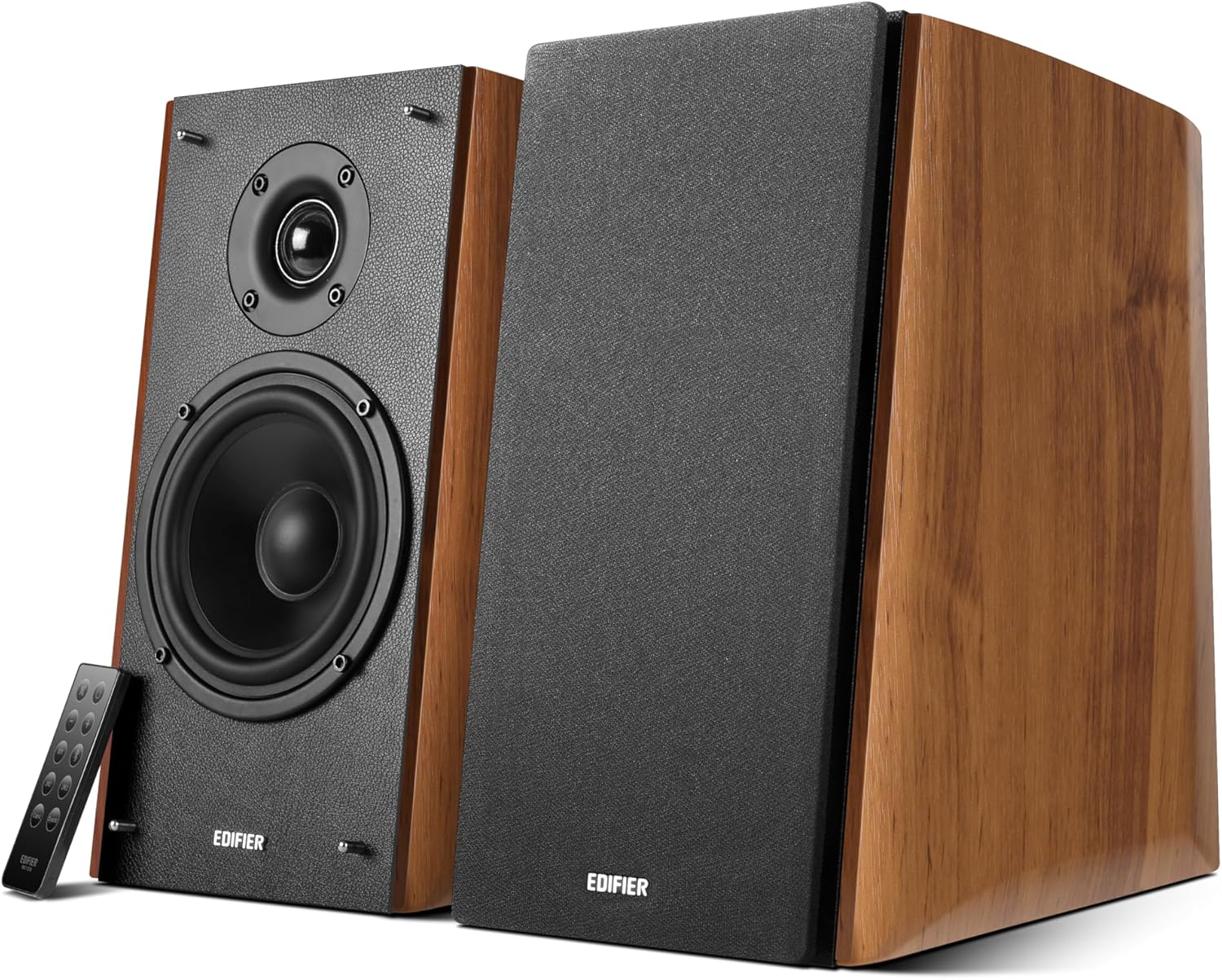
Step up to the R2000DB and you get a 5.5-inch woofer, a silk dome tweeter, Bluetooth 5.0, optical input, and coaxial input — all in one box. At around $300, it's double the R1280T's price, and whether that's worth it depends entirely on how many inputs your setup needs and whether you can hear the driver quality difference at desk distances. Published audiophile reviews suggest the larger driver and dome tweeter deliver meaningfully better imaging near-field; owner reports on the Bluetooth reliability are broadly positive with rare exceptions noted around firmware earlier in the product's life.
Best for: power users who need Bluetooth + optical + coaxial in a single speaker and want a noticeable step up from entry-level Edifier tuning.
Polk Audio T15 — Best Budget Passive Option
The T15 is a passive bookshelf speaker at roughly $149 for a pair. That's the catch in bold: you need an amplifier or AV receiver to use these. If you already own one, the T15's driver quality and build at this price are genuinely difficult to beat — long-term owner feedback consistently praises them for music reproduction that embarrasses similarly priced powered speakers. If you don't own a receiver, the math doesn't work. Don't buy a $60 Lepai amp to power them; the combo will sound worse than a decent powered speaker at the same total cost.
Best for: buyers who already have a receiver or integrated amp and want the best passive bookshelf speaker under $150 per pair.
KEF LSX II — Best Stretch Buy
The KEF LSX II costs $1,499.99. That's not a typo, and this is not a value play. What you're getting is one of the most technically sophisticated compact speakers available at any price: DSP room correction, Wi-Fi streaming, Bluetooth aptX, HDMI ARC, optical, and USB-C, all managed by KEF's proprietary Uni-Q driver array that places the tweeter concentrically inside the midrange driver. Published expert reviews across audiophile and hi-fi outlets consistently place the LSX II at or near the top of the compact active speaker category. At desk distances, the Uni-Q driver's coherent point-source dispersion is an actual engineering advantage, not a marketing story.
Best for: buyers who are deliberate about audio quality, want to eliminate a DAC, streamer, and amplifier from their desk chain, and have the budget to make the KEF the permanent answer.
Side-by-Side Comparison
| Speaker | Type | Approx. Price | Inputs | Woofer Size | Price-per-Inch of Woofer | Best For |
|---|---|---|---|---|---|---|
| Edifier MR4 | Powered | ~$154 | USB-C, RCA, AUX | 4 in | ~$38.50 | Studio-flat tuning, USB-C direct |
| Edifier R1280T | Powered | ~$150 | 2× RCA | 4 in | ~$37.50 | All-around reliability, dual inputs |
| Edifier R2000DB | Powered | ~$300 | Bluetooth, Optical, Coaxial, RCA | 5.5 in | ~$54.50 | Multi-input power users |
| Polk Audio T15 | Passive | ~$149/pair | Binding posts (amp required) | 5.25 in | ~$28.40 | Receiver owners only |
| KEF LSX II | Powered | ~$1,500 | Wi-Fi, BT, HDMI ARC, Optical, USB-C | 4.5 in (Uni-Q) | ~$333 | Audiophile near-field, all-in-one |
On the derived column: Price-per-inch of woofer diameter is a rough proxy for driver investment at a given price point — lower means more woofer for your dollar; higher can reflect premium engineering elsewhere (DSP, cabinet, tweeter quality). The KEF's number is high by design: you're paying for the Uni-Q concentric array and onboard streaming, not raw cone diameter. The Polk's low number reflects the value case for passive — the amp cost is externalized. Use this column as a cross-check, not a verdict.
Decision Framework
Pick the Edifier R1280T if you want a powered speaker under $150 with two inputs, physical EQ controls, and 19,000+ owner reviews confirming it holds up over time.
Pick the Edifier MR4 if you're doing audio production or podcasting and want a flatter frequency response with USB-C connectivity to skip an external DAC.
Pick the Edifier R2000DB if you need Bluetooth, optical, and coaxial in a single speaker and are willing to spend $300 for noticeably better drivers.
Pick the Polk Audio T15 if you already have an amplifier or receiver and want passive bookshelf quality at under $150 a pair — otherwise, skip it.
Pick the KEF LSX II if audio quality is a genuine priority, you want to consolidate your DAC, streamer, and amplifier into one box, and the $1,500 price is in your range.
Skip powered bookshelf speakers entirely if your desk has less than 24 inches of depth or no room to position speakers off-axis — closed-back headphones will deliver better acoustics in a constrained setup.
FAQ
Do I need a DAC or amplifier with these speakers? For the powered Edifier models and the KEF LSX II — no. They have amplifiers built in. The Polk Audio T15 is passive and requires an external amplifier or receiver. A cheap class-D amp will technically work with the T15 but will likely bottleneck the speaker's capability; budget accordingly.
What's the most common mistake buyers make with desk speakers? Buying for spec sheet frequency response without accounting for near-field positioning. A speaker with impressive bass extension measured at 1 meter in an anechoic chamber will sound muddy and boomy at 20 inches from your head, especially if it's close to a rear wall. This is why rear-ported speakers (like the R1280T) should be pulled a few inches from the wall, and why EQ controls matter more at a desk than in a living room. Owner complaints about "too much bass" on otherwise well-reviewed speakers almost always trace back to placement, not the driver.
Is Bluetooth good enough for desk speakers? For music listening and casual video, Bluetooth aptX or AAC is fine. For video production or gaming where lip-sync matters, Bluetooth's latency (typically 40–200ms depending on codec and hardware) can cause noticeable sync drift. Use a wired connection — optical or RCA — for latency-sensitive work. The KEF LSX II and R2000DB both offer optical for this reason.
Can I use these speakers without a subwoofer? For most desk listening — yes. A 4-inch woofer in a ported enclosure will handle bass adequately for music and general audio at near-field distances. If you're mixing low-frequency content or want cinematic impact, a subwoofer helps, but it also introduces placement complexity on a desk. Start without one; add it only if you identify a real gap.
How We Chose
Selection started with roughly nine powered and passive bookshelf models actively available and frequently recommended for near-field desk use as of mid-2026. Products were evaluated against published expert reviews from hi-fi and home office outlets, long-term owner feedback aggregated from Reddit (particularly r/BudgetAudiophile and r/homeoffice), and manufacturer specification sheets. Dominant selection criteria: near-field driver tuning, input flexibility, footprint suitability for desk use, and the volume and consistency of long-term owner reports — a speaker with 200 reviews gets less benefit of the doubt than one with 7,000+. Passive speakers were included only where the driver quality case was strong enough to justify the amp-required caveat. Warranty terms and owner-reported failure modes (port rattle, amplifier noise, Bluetooth dropout) were weighted alongside audio performance. Four products were cut for thin owner feedback, redundant positioning, or input limitations that made them worse desk options than their audio quality alone would suggest.
Bottom Line
For most people building a home office audio setup, the Edifier R1280T is the answer: proven, flexible, correctly priced, and backed by years of owner feedback that confirms it holds up. If you're doing audio work and want a flatter tuning curve with USB-C connectivity, the Edifier MR4 is a lateral move worth considering at the same price tier. The Edifier R2000DB earns its $300 price if you genuinely need Bluetooth and optical in a single unit. The Polk Audio T15 is excellent value — if, and only if, you're already running a receiver. And the KEF LSX II is the only speaker here that changes the nature of your desk audio setup entirely: it eliminates the need for a separate DAC, amplifier, or streamer, and delivers near-field performance that published expert reviews consistently rank at the top of the compact active speaker category. The price is real. So is the quality.