
Cable Clips vs Spiral Wrap: Which Actually Works?
This article contains affiliate links. If you purchase through these links, we may earn a small commission at no extra cost to you.
This matchup comes down to one question: are your cables stationary, or do they move?
Clips are point anchors. Spiral wrap is a sleeve. Neither is universally better — but buying the wrong one means you'll either peel adhesive off your desk in three months or wrestle with a bundle that looks worse than bare cables. Most desks need one or the other, not both. Here's how to figure out which.
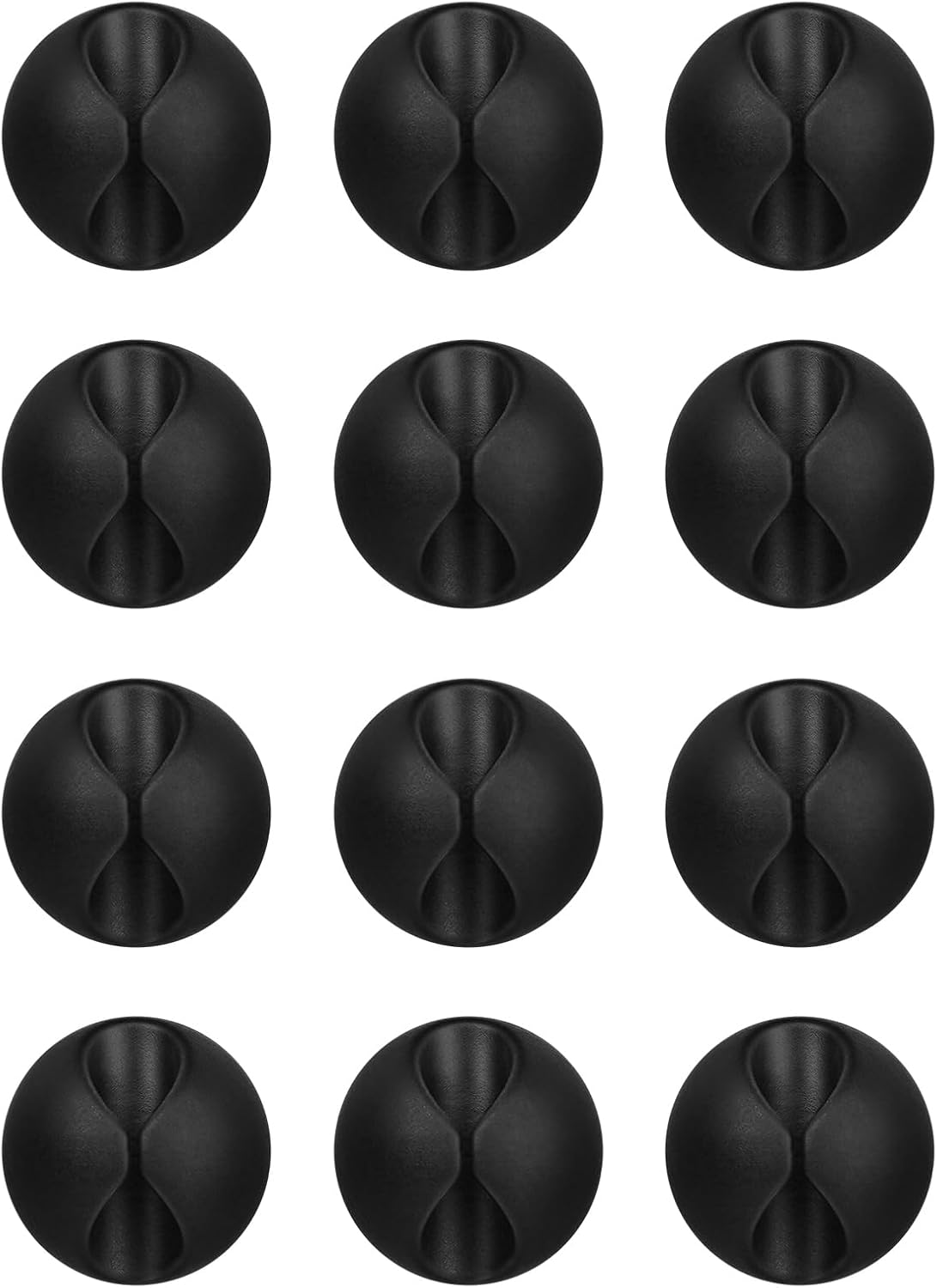
Flezoo Adhesive Cable Clips
The Flezoo clips are small, adhesive-backed channels — each one grips a single cable (or a tight pair) and sticks to a flat surface. At roughly $4.99 for a multi-pack, they're cheap enough to run a full desk perimeter without overthinking it.
The 2,399 reviews and 4.6-star average are legitimately good for a commodity cable accessory. Owner reports on the negative end cluster around two issues: adhesion failure on textured or powder-coated surfaces, and clips cracking when forced over thick cables (anything above roughly 6mm diameter gets reported as a fight). Neither is a dealbreaker if you match the product to the job — smooth desk undersides, standard USB-A/USB-C and display cables.
Spiral Cable Wrap
Spiral wrap is flexible split-loom tubing wound in a helix. You spin it onto a cable bundle (or a single cable you want protected), and it holds the group together in a neat sleeve. At roughly $6.99 for a roll, you're buying linear coverage — not individual anchor points.
The 867-review pool is smaller but the 4.5-star average holds up. Reported gripes lean toward sizing: buyers who don't measure cable diameter before ordering end up with wrap that's too loose to stay tidy or too tight to flex without cracking. The other common complaint is that wrapping takes time — owner reports suggest a fully bundled desk's worth of cables takes 20–40 minutes of actual hands-on work versus five minutes for a clip row.
Head-to-Head Breakdown
Adhesion and Surface Compatibility
Clips live and die by their adhesive. Based on owner reports, the Flezoo clips hold reliably on smooth painted wood, glass, and metal desk surfaces. Powder-coated steel legs and textured particle board are recurring failure points — the adhesive doesn't wet out properly and clips fall off within weeks. Spiral wrap avoids this problem entirely: it doesn't mount to anything. This is a decisive advantage for standing desks, wire-management trays, or any setup where the routing surface isn't smooth.
Winner: Spiral wrap on hostile surfaces. Clips on clean, flat desk undersides.
Bundle Capacity
Each Flezoo clip handles one, maybe two slender cables cleanly. Run more than that through a single clip and the published design intent breaks down — owner reports describe the slot deforming or the adhesive peeling under lateral load. Spiral wrap, by contrast, bundles whatever diameter you feed it. If your desk has a power strip, monitor cable, two USB runs, and headphone cable all traveling the same path, wrap handles that as one unit. Clips require one anchor per cable, which multiplies cost and visual noise.
Winner: Spiral wrap for multi-cable runs. Clips for individual cable routing.
Reconfigurability
Clips are semi-permanent. Removing them risks surface damage and the adhesive pad is typically single-use. If you rearrange your setup seasonally or swap peripherals often, you'll be buying new clips and dealing with adhesive residue. Spiral wrap unspools and respools — it travels with the cable, not the desk. For a setup that evolves, that matters.
Winner: Spiral wrap for flexible setups. Clips for stable, set-it-and-forget-it desks.
Aesthetics and Visibility
Clips are nearly invisible once installed — a small nub flush against the desk edge. Spiral wrap is visible by nature; it's a bundle on top of or hanging from the surface. In a clean desk build where individual cables are carefully routed to disappear, clips win. In an under-desk tray or cable raceway where concealment is handled separately, wrap is neater because it prevents spaghetti.
Winner: Clips for exposed single-cable routing. Spiral wrap for tray-routed bundles.
At a Glance
| Flezoo Adhesive Clips | Spiral Cable Wrap | |
|---|---|---|
| Typical price | ~$4.99 / pack | ~$6.99 / roll |
| Star rating (review count) | 4.6★ (2,399) | 4.5★ (867) |
| Per-cable cost (est.) | ~$0.25–$0.50/clip | Covers ~5–10 ft of bundle |
| Max cable diameter (reported) | ~6mm comfortably | Scales with wrap diameter ordered |
| Surface requirement | Smooth/flat adhesion | None — wraps cables directly |
| Reconfigurable | No (adhesive, single-use) | Yes |
| Install time (full desk) | ~5 min | ~20–40 min |
| Cost per linear foot managed | Higher (one clip per point) | Lower on long multi-cable runs |
The derived metric that matters most here: cost per linear foot of managed cable. Clips are efficient when you have a handful of cables and short runs — but the per-unit cost stacks fast on a long routing path with five cables. Spiral wrap's cost advantage grows with run length and bundle size.
Which One Is Right for You
Buy the Flezoo Adhesive Clips if your desk surface is smooth, your cables are stationary, and you're routing individual lines (monitor cable along the back edge, charging cable down a leg) that you won't move for months.
Buy the Spiral Cable Wrap if you have three or more cables traveling the same path, your routing surface isn't adhesive-friendly, you have a standing desk that flexes, or you reconfigure your setup more than twice a year.
Skip both if your actual problem is cable drop-off the back of the desk or a completely exposed power strip — a cable management tray or under-desk raceway solves that at the source, and clips or wrap on top of it is just trim work.
Bottom Line
Clips and spiral wrap solve different problems. Clips are the right call for a stable desk with a few individually routed cables on clean surfaces — fast to install, nearly invisible, cheap per cable if your run count is low. Spiral wrap earns its place the moment cables start traveling in groups, surfaces get uneven, or your desk layout changes with any regularity. Buy clips for static, simple routing. Buy wrap for bundles, standing desks, and anything that moves. If you're still unsure, look at the cable count on your current desk: one to three cables going different directions means clips; four or more heading the same way means wrap.