
Velcro Cable Ties vs Adhesive Cable Clips: Which Wins?
This article contains affiliate links. If you purchase through these links, we may earn a small commission at no extra cost to you.
Buy the VELCRO Brand ONE-Wrap ties if your cable layout changes, if you're renting, or if you care about desk surface integrity. Buy the Flezoo adhesive clips if you have a permanent, simple single-cable run and want to spend as little as possible. The price gap is real — roughly $11 separates them — but so is the use-case gap.
At a Glance
| VELCRO ONE-Wrap | Flezoo Adhesive Clips | |
|---|---|---|
| Typical price | ~$15.89 | ~$4.99 |
| Units per pack | 100 ties | ~60 clips (varies by pack) |
| Price per unit | ~$0.16/tie | ~$0.08/clip |
| Attachment method | Self-fastening hook-and-loop wrap | Adhesive pad + clip channel |
| Reusable? | Yes — indefinitely | No (adhesive is single-use) |
| Surface contact | None (wraps around cable) | Requires clean, flat surface |
| Best cable diameter | Up to ~1 in. bundled | Single cable, ~4–6 mm |
| Removal risk | None | Low–moderate (paint/finish dependent) |
| Rating / reviews | 4.7★ / 36,805 reviews | 4.6★ / 2,399 reviews |
| Reuses before replacement | Effectively unlimited | 1 |
The derived metric that matters most here is cost-per-reuse. Flezoo's $0.08/clip looks better than VELCRO's $0.16/tie — until you factor in that every time you move a cable, the adhesive clip is done. VELCRO's per-reuse cost trends toward zero over time. If you touch your cable layout more than once, the math flips hard.
VELCRO Brand ONE-Wrap Cable Ties
The ONE-Wrap is the closest thing cable management has to a solved problem. The hook-and-loop design wraps around the cable bundle itself — nothing touches your desk, no surface prep required, no risk to your finish. The 100-count pack at roughly $15.89 (typical) gives you enough to do a full workstation, a monitor arm's worth of cable routing, and still have spares for the next time you add a peripheral.
With over 36,000 Amazon reviews at 4.7 stars, the owner sample is large enough to be meaningful. Published desk-setup community feedback consistently flags these as the default recommendation for anyone who moves gear, switches monitors, or simply hates commitment.
Flezoo Adhesive Cable Clips
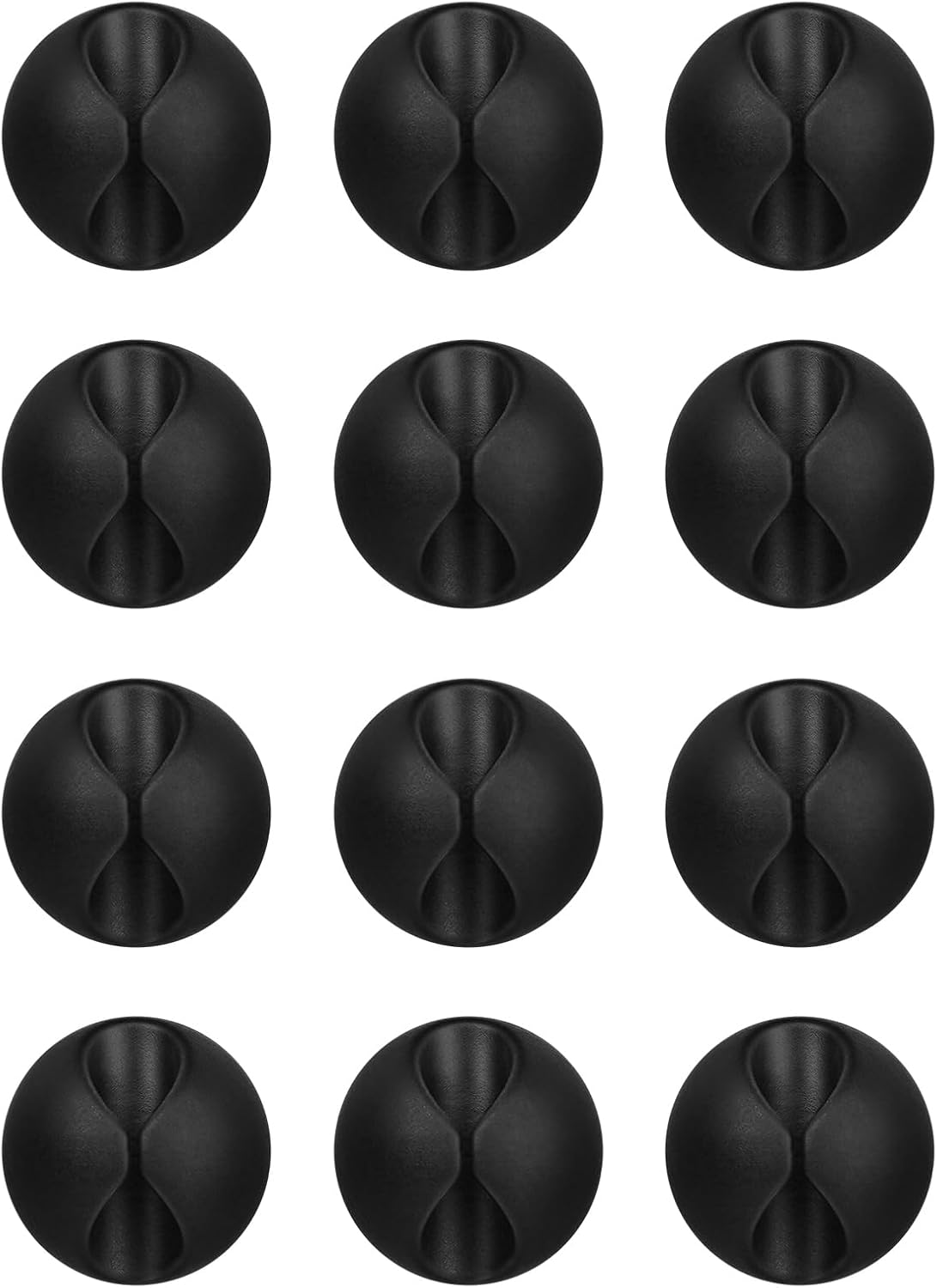
Flezoo's clips are the right answer for a narrow but real use case: you have one or two cables that need to follow a fixed path along a wall, baseboard, or desk edge, and you are confident that path will not change. At ~$4.99 for the pack, the barrier to trying them is nearly zero.
The 4.6-star rating across 2,399 reviews is solid, though the review pool is small enough that failure modes may be underrepresented. Owner reports on Amazon and Reddit forums flag the usual adhesive-clip gotchas: poor adhesion on textured or powder-coated surfaces, and a tendency to leave residue or lift paint on removal — particularly on drywall and lacquered wood. Surface prep (clean, dry, ideally wiped with isopropyl) meaningfully improves hold, but it's a step most people skip.
Head-to-Head Breakdown
Reusability and flexibility
VELCRO wins this decisively. The ONE-Wrap mechanism has no meaningful wear limit under normal use — owner reports regularly mention sets lasting years. Flezoo clips are single-use by design: once the adhesive pad bonds to a surface, separating it means either destroying the clip or risking the surface. For anyone who upgrades peripherals, changes monitor configurations, or works at a standing desk with cables in motion, this isn't a close call.
Surface safety
VELCRO has no surface risk because it touches only the cables, not the desk or wall. Flezoo's adhesive clips introduce real risk on painted drywall, lacquered wood, or any finish that hasn't fully cured. Owner one-star reviews for adhesive clips in general — and Flezoo's specifically — cluster around two complaints: clips that fall off quickly on certain surfaces, and paint that peels on removal. Renters should treat any adhesive clip as a liability without testing first.
Cable capacity and routing type
These products solve different problems. VELCRO ties are bundlers — they gather multiple cables into a managed loom. Flezoo clips are guides — they hold a single cable flat against a surface. Neither replaces the other cleanly. A fully managed desk often uses both: ties to bundle from the desk down, clips to route a lone cable along a wall channel. If you only buy one, ties give you more flexibility; clips give you more surface-following precision.
Value at scale
At face value, Flezoo is cheaper per unit. But for a full desk setup — monitor, PC, peripherals, charging cables — you might need 20–40 clip points. If you ever reconfigure, every one of those is a replacement purchase. The VELCRO set at $15.89 handles the same job repeatedly. For long-term, moderate-complexity setups, the total cost of ownership favors VELCRO within the first reconfiguration.
Which One Is For You?
Buy VELCRO Brand ONE-Wrap Cable Ties if you have more than a handful of cables to manage, you reconfigure your desk with any regularity, or you rent — no surface contact means no risk and no awkward conversations with landlords.
Buy Flezoo Adhesive Cable Clips if you have one or two cables that need to follow a permanent path (think: a single monitor cable along the back edge of a desk), your surface is smooth and non-porous, and you are genuinely confident that route won't change.
Skip both if you need to route cables vertically along a desk leg or around a monitor arm with complex angles — an under-desk cable management tray or cable raceway handles that job better than either of these.
Bottom Line
For most remote workers managing a real desk setup, VELCRO ONE-Wrap is the right default. The scale of its owner base, its zero surface-risk design, and its indefinite reusability outweigh the $11 price premium over Flezoo almost immediately. Flezoo earns its place as a targeted, ultra-cheap fix for simple permanent runs — but its value proposition evaporates the first time you need to move a cable. Buy VELCRO first. Add Flezoo clips only if you have a specific single-cable routing job they're suited for.